The Classroom Needs You

“Tell me and I forget. Teach me and I may remember. Involve me and I learn.”
— Xunzi
A classroom can have all the routines in the world and still feel like a place where children are simply being told what to do.
We know how the morning goes. Bags go here, coats go there, books come out, chairs are pushed in, someone needs a pencil, someone else needs help, and somehow there is always one child who has already asked what time lunch is before the attendance is finished.
Routines help us manage all of that. They give children predictability and help the day run more smoothly. But there is another question worth asking: Are children simply following the routines, or are they becoming part of the work of making the classroom run?
That distinction matters.
In last week’s blog, we looked at Classroom Agreements and how inviting children to help shape expectations can build a culture of ownership. This week, we are taking that idea one step further with Job Charts, because one of the simplest ways to help children feel that they belong somewhere is to give them something meaningful to contribute.
We have probably all seen classroom jobs before:
Line leader
Door holder
Attendance manager
Book organiser
Table helper
There is nothing wrong with these jobs, and children often enjoy having a special responsibility. But Job Sharing can be about more than keeping the classroom tidy or giving everyone a turn at being the helper of the day.
They can communicate something much more important: You have a part to play here.
Children need to experience belonging, but they also need to experience significance.
They need to know that they are not simply people who come into the classroom each morning, follow instructions, complete their work, and leave at the end of the day. They are members of a community, and communities work because people contribute to them.
That might mean looking after the class plants, checking that resources are ready, helping organise materials, welcoming someone into the room, or making sure a particular part of the classroom is cared for.
The job itself is not really the point. The message underneath it is: “We need you.”
This is where I think it is helpful to resist making every classroom responsibility another thing we manage for children. If we create the Job Sharing Chart, assign every role, decide exactly how it should be done, and then remind children constantly to complete their jobs, we may have a very efficient system, but we have missed some of the opportunity for ownership.
What might happen if children helped decide what jobs the classroom actually needs?
We might ask, “What things need doing to help our classroom work well?” or “What could we each take responsibility for?”
They may notice things we have overlooked. They might also have ideas about how a job could be done differently or what would make it easier for everyone.
Again, this does not mean handing over all responsibility to children. We are still the adults in the room. We still provide structure, guidance, and boundaries. But we can create opportunities for children to participate in the running of their community rather than simply responding to adult instructions.
And that participation builds habits.
When a child gets used to putting the art materials away because they know they are responsible for checking them, or remembers to water the plants because the class depends on them to do it, contribution becomes part of the rhythm of the day.
Eventually, we hope children begin to notice what needs doing without waiting for someone to tell them.
That is a very different kind of independence.
There is also something lovely that happens when children begin to see one another as contributors.
It gives us more opportunities to notice children's strengths.
Q-Tips for Building a Culture of Contribution

1. Create jobs with children, not just for them
Ask children what needs to be done to keep the classroom working well. Their answers can become the starting point for your Job Sharing Chart.
2. Make responsibilities meaningful
A job should give children a genuine opportunity to contribute. If possible, avoid creating roles simply because you need something done. Think about what will help children experience responsibility and significance too.
3. Give children a voice in how jobs work
Once the jobs are identified, ask children how they think each one could be managed. You may be surprised by their practical ideas.
4. Rotate opportunities, not just titles
Try to make sure different children get opportunities to experience different kinds of contribution. Some children may naturally gravitate towards certain jobs, but everyone benefits from discovering new capabilities.
5. Notice the contribution, not just the completion
Instead of focusing only on whether a job was done correctly, notice the difference the child made. “You helped make sure everyone had what they needed” tells a child much more than “Good job.”
A Job Chart might look like a small thing on the classroom wall, but the culture behind it can be much bigger.
When children are given meaningful ways to contribute, we are teaching them that belonging is not just about having a place in the room. It is also about having a role in the life of the community.
And like the agreements we talked about last week, this takes time. There will be forgotten jobs, jobs done differently than we would have done them, and the occasional child who suddenly remembers their responsibility approximately five minutes after it was supposed to happen.
That is part of the learning.
We are not trying to create perfectly efficient little adults. We are helping children practise responsibility, cooperation, initiative, and the feeling that what they do matters to other people.
Because a classroom culture of ownership grows when children can look around and realise that they are not simply in this classroom. They are part of it.
BEFORE YOU GO….
Want a little help getting started?
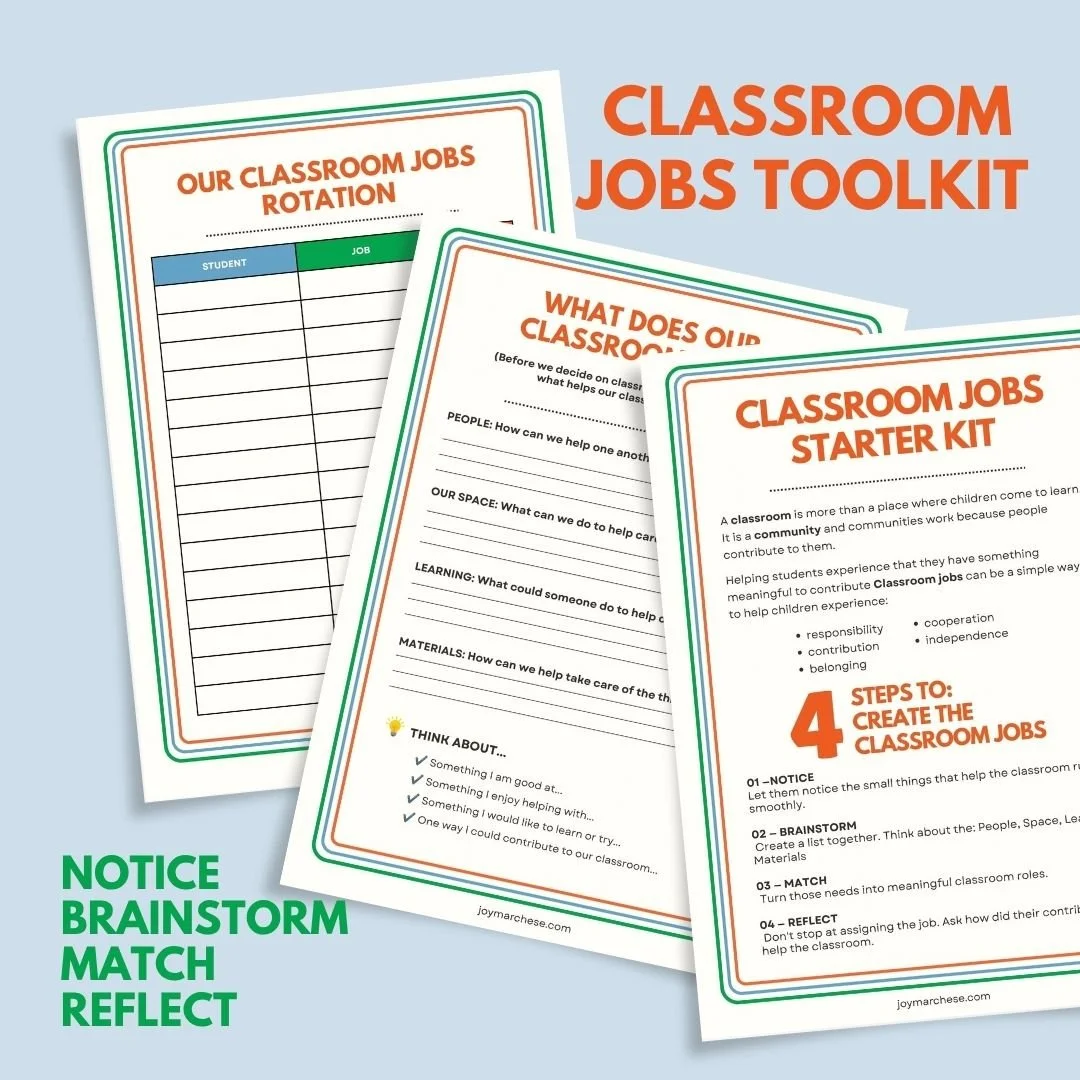
We’ve created a free Classroom Jobs Toolkit to help you put these ideas into practice. It’s a handy resource for introducing classroom responsibilities and making it easier for children to take an active part in caring for their classroom.
I want to leave you with something practical for those conversations.
Small Talk: 101 Conversation Cards for Deeper Connection is now available to order.
If this month's series has reminded you of the value of real conversation, I'd love to share something I created with that in mind designed to spark meaningful, screen-free conversations, these cards help turn ordinary moments into memorable ones.
Because sometimes, all it takes is one good question.
Order now at joymarchese.com/shop.
Do you want to bring us directly to your school or organization ?
From leadership teams to full faculty, we offer customized workshops that equip educators to integrate SEL and Educational Neuroscience seamlessly into everyday teaching.
💡 Let’s partner to build stronger, more connected school communities—together.