
“Well done is better than well said.”
— Benjamin Franklin
How was your Halloween? More importantly, how is the candy situation holding up?
If your house is anything like most, there’s probably a bucket somewhere that was going to be “sorted tomorrow,” a plastic spider still crawling up the stairs, or a pumpkin on the porch that was definitely going to be dealt with by the end of the week. Nobody meant to leave them there. On Saturday night a child said, “I’ll put it all away tomorrow, I promise” with total sincerity, and tomorrow turned into Monday, and the spider is still on the stairs.
The promise was real, and so was the good intention. But excitement has a way of outlasting promises, and somewhere between the saying and the doing, the child goes missing in action.
It happens on ordinary days too, when the lunchbox never makes it home. Kids aren’t careless on purpose. They’re small people with a lot of expectations to meet.
Every place has its own unwritten rules, and a child is learning all of them at once, with a brain that is still under construction. It’s a wonder anything gets finished.
It’s tempting to treat moments like these as the whole story of responsibility. They aren’t. They’re simply the part we all recognise, which makes them a good place to start, because this November I want to talk about something bigger than the lunchbox. I want to talk about why giving children real responsibility, and teaching them how to contribute, shapes the way they see themselves.
Positive Discipline grows out of Alfred Adler’s belief that the deepest human need is belonging and significance.
We want to know we’re part of something, and we want to know we matter to it. Children are no different, and they’re constantly collecting evidence. Contribution is some of the strongest evidence they can find.
When a child sets the table, welcomes a new classmate, feeds the dog, or offers an idea in a class meeting, they’re doing more than finishing a task. They’re discovering that the group they belong to is better because they’re in it.
That’s the difference between compliance and contribution.
Compliance asks, “Did you do what I told you?”
Contribution asks, “What does this family, this classroom, this community need, and what can you offer?”
A child who is only told what to do learns to wait for instructions. A child who is invited in learns to look around, notice what needs doing, and see themselves as someone capable of helping.
Rudolf Dreikurs, who brought Adler’s ideas into parenting and classrooms, put it plainly: a misbehaving child is a discouraged child. When children have no meaningful way to belong, they will find other ways, and we tend to call those ways misbehaviour.
Of course, children will get it wrong along the way, and that deserves some compassion.
Just think about what we ask of them in a single day.
At school they’re meant to be focused, organised, and ready. With friends they’re meant to be fair, kind, and good sports. At home they’re meant to be helpful, remember everything, and do it all without being asked twice. They’re doing this with brains that are still being built, at the end of a long day, with a head full of other things.
Plenty of adults still forget the permission slip or leave the washing in the machine for a second night, and we call that being human. In a child we sometimes call it carelessness. This is unfair.
So how we respond to the slip matters as much as the responsibility itself, and this is where one of the most useful tools in Positive Discipline comes in: being kind and firm at the same time.
Jane Nelsen, who developed the model, points out that most of us swing between two extremes.
Firm without kindness becomes control: the sigh, the sharp tone, the “forget about it, I’ll do it myself.” Kindness without firmness becomes permissiveness, where the job quietly disappears because we were tired or didn’t have the energy to follow through.
Neither teaches much.
Kindness shows respect for the child, and firmness shows respect for ourselves and for what the situation needs. Children learn responsibility when they get both together.
It might sound like this: “I know you meant to return that book, and I know it slipped your mind. Someone else is waiting to read it, so it’s going back tomorrow. What would help you remember?”
The first sentence is kind.
The second is firm, because the expectation stays and so does the follow-through. The last is a curiosity question, which hands the problem back to the child and lets them help design the solution.

Positive Discipline treats mistakes as opportunities to learn, but the learning only happens when the child feels safe enough to look at what went wrong.
A child who is ashamed can only hear the shame.
And yes, we’re still allowed to teach. Children need to hear why things matter, and sometimes that means a proper talk. Positive Discipline simply asks us to connect before we correct, to say it once and clearly, and then to ask the child what they think.
A child who has been asked listens far better than one who has only been told.
But I want to emphasize this: children don’t earn their place by being useful. They already belong. Contribution is simply where that belonging starts to show.
There’s a reason I want to explore all of this in November. It’s a season for noticing what we’re thankful for, and few things feel more thankful than being needed.
Over the next three weeks, we’ll follow children’s MIA moments into the different corners of their lives, and look at what grace and firmness can sound like in each.
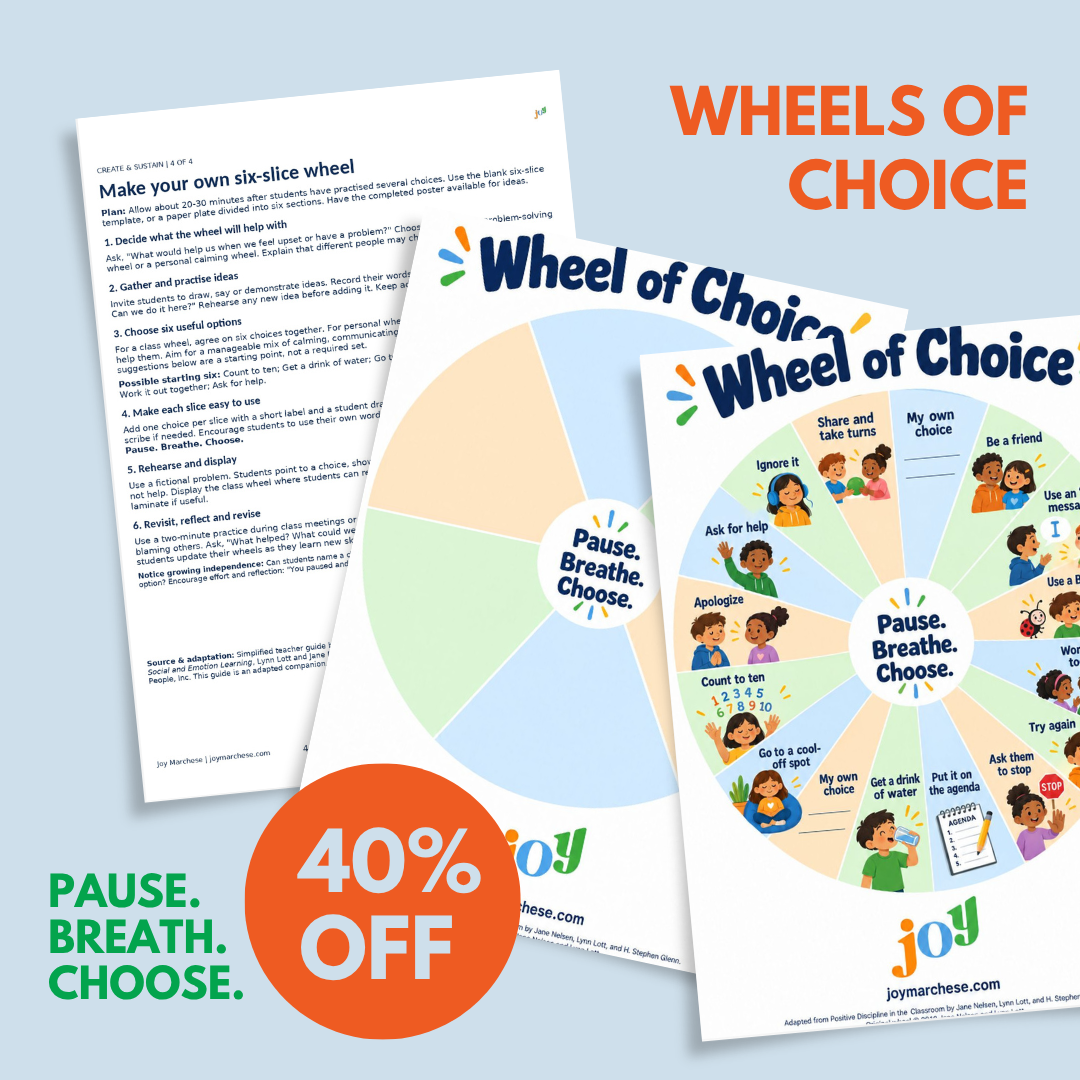
I've created a practical teaching resource to help you introduce the wheel of choice, practise different strategies with your students, and make it part of your classroom routine.
You can download the free Wheel of Choice template below to get started, or get the full teaching guide on Teachers Pay Teachers for just $3, reduced from $5 (40% off).
I want to leave you with something practical for those conversations. Why not use our Small Talk Conversation Cards during your class meetings?
Small Talk: 101 Conversation Cards for Deeper Connection is now available to order.
If this month's series has reminded you of the value of real conversation, I'd love to share something I created with that in mind designed to spark meaningful, screen-free conversations, these cards help turn ordinary moments into memorable ones.
Because sometimes, all it takes is one good question.
Order now at joymarchese.com/shop.
Do you want to bring us directly to your school or organization ?
From leadership teams to full faculty, we offer customized workshops that equip educators to integrate SEL and Educational Neuroscience seamlessly into everyday teaching.
💡 Let’s partner to build stronger, more connected school communities—together.